
Decor Accents
Finishing touches for home decor: small details that make a room feel finished

Finishing touches for home decor are the details people notice without knowing why. A room can have a good sofa, a good rug, and good light, and still feel slightly unfinished. Usually the reason is small: a builder-grade knob, a frame without a mat, a lampshade that sits crooked, a cord across the floor.
This guide is about that last ten percent. It skips the big pieces and the styled surfaces and looks at the small, often overlooked details that make a room feel complete: hardware, frames, shades, cords, books, hooks, and the edges of things. Most cost little. Some cost nothing at all.
Look closely. Then fix one thing at a time.
Finishing touches for home decor: what a finished room has
Walk into a room that feels complete and look at the edges. The frames hang level. The lampshades match their bases. The cords disappear. The hardware on the doors and drawers repeats one finish. Nothing is shouting, but nothing has been forgotten either.
In older houses, like the New England capes and colonials with original trim, a lot of this finish is already built in: solid doors, real hardware, painted molding. In newer homes, the same effect has to be added in small pieces. Either way, start by listing what feels unfinished in the room you have:
- Edges: bare bulbs, unframed prints, curtains that stop short, a rug that sits too far from the furniture.
- Mixed finishes: three metals and four woods with no pattern.
- Visible clutter that has no home: chargers, keys, remotes, mail.
The fixes below go roughly from cheapest to most involved.
Hardware: one finish, repeated
Knobs, pulls, hooks, and switch plates are small, but they sit at hand height in every room. When they repeat one finish, the room reads as considered. When they are a mix of whatever came with the house, it reads as temporary.
- Choose one main finish per room: aged brass, black, or brushed nickel, plus wood if you like.
- Swap the most visible pieces first: dresser pulls, cabinet knobs, and the hooks by the door.
- Switch plates and outlet covers: plain painted or matching metal plates look calmer than mismatched plastic.
Renters can make many of these changes and reverse them later. Keep the original pieces in a labeled bag, check the lease, and follow the maker's instructions for any new hardware.
Frames and mats that look intentional
A print looks twice as finished in a frame with a mat. The white or cream border gives the image breathing room and makes even an inexpensive piece look deliberate.
- Use mats generously: a wide mat around a small print makes it read as a larger, more serious piece.
- Repeat frame finishes: one or two across the room, such as oak and black.
- Hang at the right height: center art about 57 to 60 inches from the floor on an open wall, and 8 to 10 inches above a sofa back.
- Keep spacing even: 2 to 3 inches between frames in a group.
Level every frame. A picture that hangs a few degrees off is one of the most common details that makes a room feel unfinished.
Lampshades, bulbs, and cords
Lighting is where small details make the biggest difference after dark.
- Shades: a shade should cover the bulb and the hardware at eye level. Fabric, linen, and paper shades diffuse light; a cheap, shiny shade looks thin when lit.
- Bulbs: use warm 2700K bulbs in lamps in living rooms and bedrooms, and keep the same warmth in every lamp in a room. Mixed bulb colors make a room look patched together.
- Cords: route lamp cords behind furniture legs or along baseboards, and bundle them with simple fabric ties. A cord crossing open floor undoes a lot of careful styling.
A plug-in wall light is a good finishing touch in a corner that stays dark, especially for renters who cannot add wiring.
Books, objects, and the small things on surfaces
Books are among the best finishing touches because they add color, height, and personality at once. Stack a few horizontally to lift a small object, or stand a short run upright between two heavier pieces.
Give every accent a job. A small dish by the door catches keys. A box on the coffee table hides remotes. A tray on the dresser collects jewelry. When a small object has a job, it stops looking like clutter.
Group what is left in odd numbers, mixing heights, and leave about a third of every surface empty.
Textile edges: hems, rugs, and covers
Fabric shows the difference between finished and almost finished more than anything else in a room, because its edges are always visible.
- Curtain hems: panels should just touch the floor or stop up to about half an inch above it. A hem that stops several inches short looks borrowed from another window.
- Rug edges: leave about 8 to 18 inches of bare floor between the rug and the walls in a living room, and keep the rug straight to the furniture. A rug that sits crooked or floats away from the seating looks like it arrived yesterday.
- Pillow covers: use inserts slightly larger than the cover so the corners fill out. Flat, empty corners make a sofa look tired.
- Bed skirts and throws: steam them once after washing. Creases from the package say temporary.
- Lampshade seams: turn every seam to the back, toward the wall.
None of these take long. Together, they change how the room reads from the doorway, because the eye notices sagging, crooked, and creased edges before it notices color.
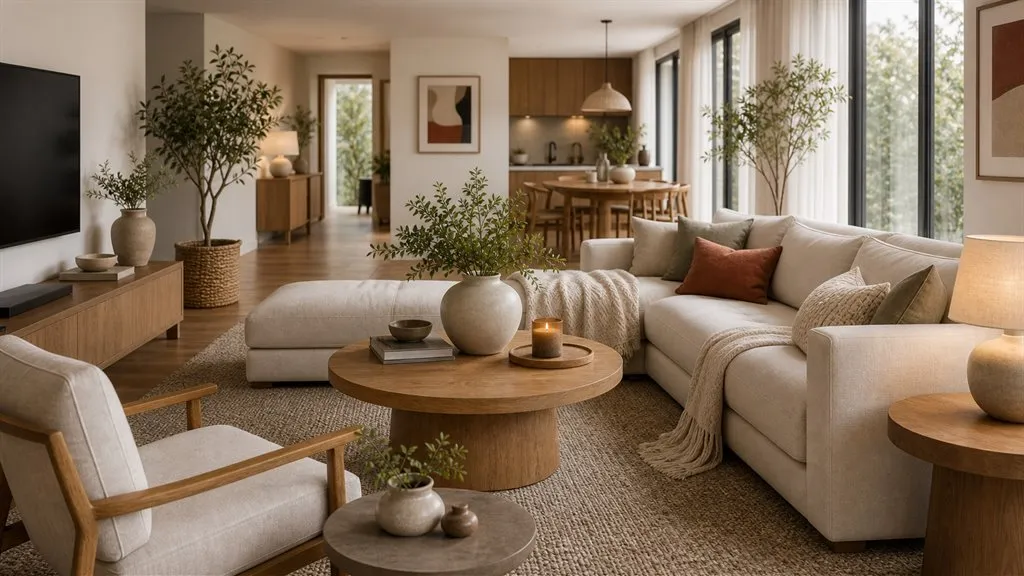
Finishing touches for the living room
The living room collects the most details because it does the most jobs.
- A throw folded over one arm of the sofa.
- A lamp at each end of the sofa, or one lamp and a plug-in wall light.
- Curtains that just touch the floor and hang wider than the window.
- A rug with the front legs of the sofa and chairs on it.
- One living thing: a plant, a branch in a heavy vase, or seasonal stems.
Finishing touches for the bedroom and dining room
In the bedroom, the details that matter most are the ones you touch every day.
- Nightstands: a lamp, a small dish, and a book, with the top within about 2 inches of the mattress height.
- Bedding: pillowcases and a duvet in close tones, with one textured throw at the foot.
- Hooks: one hook for a robe or a bag keeps clothes off chairs.
In the dining room, the finish comes from the table and the light above it.
- A runner or a bare table with one centerpiece low enough to see over.
- A pendant hung 30 to 36 inches above the tabletop with an 8-foot ceiling.
- Chairs pushed in and aligned, which costs nothing and looks finished.
Finishing touches for walls
Walls carry details beyond art.
- Mirrors placed to reflect a window or a lamp.
- Hooks and pegs in the entry, in one finish, at a consistent height.
- Picture ledges for rotating art without new nail holes.
- One bare wall in every room, so the others have room to work.
Anchor heavy mirrors and shelves into studs or rated anchors, and check the lease, HOA, or building rules before drilling.
The last edit
Finishing a room is as much about taking away as adding. Walk through once more and look at the details only.
- Straighten every frame and lampshade.
- Match the bulb colors.
- Hide the cords.
- Take one small object off the busiest surface.
Then check it in daylight and lamplight. Details that look fine at noon, like a shiny frame or a bare bulb, can stand out at night. For more ways to finish a room with lighting, textiles, wall decor, and table styling, the guide to modern home decor accent ideas brings the bigger accent pieces together.
Frequently asked questions
What does finishing touches mean in home decor?
Finishing touches are the small details that make a room feel complete: matching hardware, framed and matted art, good lampshades, hidden cords, books, plants, and a few objects with a clear purpose.
How do you finish a room that feels empty?
Add one lamp, one textile, and one larger piece of art before buying more small objects. Then fix the edges: frames, shades, cords, and curtains.
What are the cheapest finishing touches?
Straightening frames, matching bulb colors, hiding cords, moving books into small stacks, and editing busy surfaces cost nothing. Mats, fabric cord ties, and a single plant cost little.
Should hardware match in every room?
Within a room, one main finish looks calm. Across the house, you can change finishes from room to room, as long as each room repeats its own.
Related guides
Decor Accents
Modern home decor accent ideas a complete guide to styling a warm polished home
Explore modern home decor accent ideas using color, texture, lighting, rugs, trays, and simple styling choices for a warm, polished home that feels practical.

Decor Accents
Neutral fall decor ideas for a living room that does not look themed
Neutral fall decor for the living room: camel, olive, wool, and lamplight instead of orange props. A calm, surface-by-surface guide.

Decor Accents
How to choose accent pieces for a neutral living room
A practical guide to choosing accent pieces for a neutral living room with calm color balanced texture useful scale and a clean modern look