
Decor Accents
Calm room decor ideas: how to quiet a busy room with accents

The best calm room decor ideas are rarely about buying something new. A room feels calm when the eye can rest: fewer things competing for attention, surfaces that look intentional, and light that stays soft after dark. Most of that is decided by the accents, the small and medium pieces that sit on tables, shelves, walls, and sofas.
This guide works with the furniture you already have. It looks at what makes a room feel busy, then quiets it accent by accent: color, texture, weight, sound, light, and the surfaces themselves. It ends with an edit list, because calm usually comes from taking things away.
Busy is a feeling. So is calm.
Creating a calm room starts with what is already there
Stand in the doorway and look for the loudest things in the room. They are usually not the biggest. A glossy plastic bin, a cluster of chargers, a bright logo on a box, five small frames in five different finishes. Each one is minor. Together they make the room hum.
Older rooms, like the New England colonials with deep window trim and wide floorboards, often already have quiet character in the architecture. Newer rooms with flat walls may lean harder on accents for warmth. Either way, start by noting three things:
- What already brings warmth: a wood floor, a wool rug, a linen sofa, good trim.
- What creates noise: shine, strong contrast, many small objects, visible cords, mismatched metals.
- Where the eye lands first: the wall facing the door, the coffee table, the top of a dresser.
Calm decor builds on the first list and shrinks the second. The third list tells you where to begin.
Choose one color story for the accents
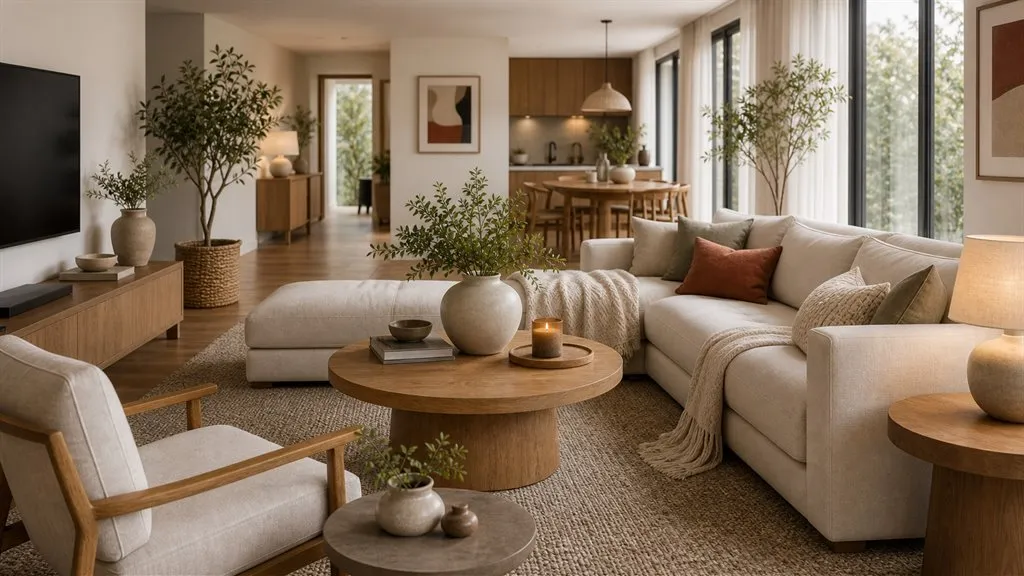
A calm room does not need to be beige. It needs fewer color decisions. Pick one family of colors for the accents and repeat it, rather than letting every pillow, vase, and print introduce something new.
Good calm color stories for accents include:
- Warm neutrals: oatmeal, cream, camel, and walnut, with black in small doses.
- Soft greens: sage and olive with natural linen and pale oak.
- Muted blues: slate and denim with warm white and brass.
Choose the color story from something that will not change, such as the rug, the sofa, or the floor. Then let every new accent repeat one of its tones. Repeat materials, not matching sets. Two pillows in the same wool, a throw in a related shade, and a ceramic bowl that picks up the rug's darkest thread will feel calmer than a coordinated set from one store.
Texture before color: matte, natural, and quiet
Shine is visually loud. Glossy ceramics, lacquered trays, and mirrored accessories bounce light around and keep the eye moving. Matte surfaces absorb light and let the eye settle.
For a calmer room, lean toward:
- Linen, washed cotton, and wool for pillows, throws, and curtains.
- Unglazed or matte-glazed stoneware for vases and bowls.
- Oiled wood for trays, frames, and small boxes.
- Paper, rattan, or fabric lampshades instead of metal or glass.
One or two reflective pieces can stay, such as an aged brass candlestick or a mirror placed to bounce daylight. The goal is not to remove all shine, only to make it the exception.
Fewer, larger pieces calm a room faster
Ten small objects read as clutter. Three larger ones read as a choice. If a shelf or table feels busy, the answer is often not fewer things in general but fewer, bigger things.
- Replace a row of small frames with one larger print.
- Replace several small vases with one tall vessel and a single branch.
- Group what remains in threes, mixing a tall piece, a low piece, and something sculptural or flat.
- Leave about a third of every surface empty. Empty space is part of the arrangement.
This is the simplest calm room decor idea, and it costs nothing. Group, shrink the count, and let the remaining pieces have room to breathe.
Calm room decor ideas, surface by surface
Each surface in a room has a job. When it does that job and little else, the room feels settled. Give every accent a job, and remove the ones that do not have one.
- Coffee table: three to five objects, grouped, with room for a cup and a book. A tray can hold the group together.
- Console or entry table: a lamp, one larger object, and a dish for keys. Nothing that needs to be moved every day.
- Open shelves: books in short runs, a few objects between them, and a third of each shelf left open. Turn some books on their side to break up long rows.
- Nightstand: a lamp, one small object or a plant, and whatever you actually use at night. Store the rest in a drawer.
- Dresser or sideboard: a lamp or a larger piece of art, one group of objects, and a clear stretch of top.
When a surface keeps filling up, it usually needs a home for something: a lidded box for remotes, a drawer for chargers, a basket for throws.
Calming wall art for the living room
Walls are the largest surfaces in a room, and they set its mood quickly. Calming wall art tends to share a few qualities: soft contrast, natural subjects or simple abstracts, and generous mats or plain frames.
- Fewer, larger pieces: one large print above the sofa often feels calmer than a crowded gallery wall.
- Height: hang art so its center sits about 57 to 60 inches from the floor on an open wall.
- Above furniture: leave about 8 to 10 inches between the sofa back and the bottom of the frame, and aim for art about two-thirds the width of the sofa.
- Frames: repeat one or two finishes, such as oak and black, across the room.
Leave at least one wall mostly bare. A quiet wall gives the art on the others more room to work.
Soften sound and touch, not only the look
Calm is not only visual. A room with hard floors, bare walls, and leather seating can echo, and an echoing room never feels fully relaxed. Soft accents absorb sound as well as light.
- Rugs: a wool or cotton rug under the seating group quiets footsteps and voices.
- Curtains: full-length linen or cotton panels soften the hard plane of glass.
- Upholstered pieces: a fabric ottoman, a cushioned bench, or a reading chair.
- Textiles you can touch: a wool throw, a linen pillow, a cotton blanket on the bed.
Touch matters too. Reach for the pieces you like to hold: a smooth stone, a heavy mug, a nubby throw. They make a room feel calm in a way that no photograph shows.
Soft light for calm evenings
A calm room at noon can feel harsh at night under a single ceiling fixture. Use warm 2700K bulbs in lamps, and aim for at least three light sources besides the ceiling light in a living room, set at different heights: a table lamp, a floor lamp, and a wall light or candle.
Fabric and paper shades diffuse the light; bare bulbs and clear glass do not. Place lamps where the room feels dark in the evening, often the corners and the far side of the sofa. Then look at the room after dark as well as at noon. Some neutrals that look warm at noon turn gray at night, and a room can only feel calm if it works at both times.
The edit list: what to remove
Calm rooms are edited rooms. Walk through each surface and take away:
- Anything shiny that has no purpose.
- Duplicates, such as two candles where one is enough.
- Small objects that read as clutter from the doorway.
- Visible cords, chargers, and remotes; give them a box or a drawer.
- Decor you keep only because it was a gift and you do not like it.
Then live with the room for a few days before adding anything back. If a gap still feels empty after a week, fill it with one larger piece. For more on choosing and arranging the pieces that finish a room, the guide to modern home decor accent ideas covers lighting, textiles, wall decor, and table styling together.
Frequently asked questions
How do you create a calm living room?
Choose one color story for the accents, favor matte natural textures, group fewer and larger objects, leave about a third of every surface empty, and use warm lamps in the evening. Then edit what remains.
What are good calm bedroom decor ideas?
Keep the nightstands to a lamp and one object, use linen or washed cotton bedding in close tones, hang one larger piece of art rather than several small ones, and store everything else out of sight.
Does a calm room have to be neutral?
No. A calm room needs a limited color story, not a beige one. Soft greens, muted blues, or warm earth tones can all feel calm if they repeat and the contrast stays gentle.
How many decor objects should a calm room have?
There is no fixed number, but each surface usually needs fewer than you think: three to five grouped objects on a coffee table, and about a third of every shelf and table left empty.
Related guides
Decor Accents
Modern home decor accent ideas a complete guide to styling a warm polished home
Explore modern home decor accent ideas using color, texture, lighting, rugs, trays, and simple styling choices for a warm, polished home that feels practical.

Decor Accents
Neutral fall decor ideas for a living room that does not look themed
Neutral fall decor for the living room: camel, olive, wool, and lamplight instead of orange props. A calm, surface-by-surface guide.

Decor Accents
How to choose accent pieces for a neutral living room
A practical guide to choosing accent pieces for a neutral living room with calm color balanced texture useful scale and a clean modern look